
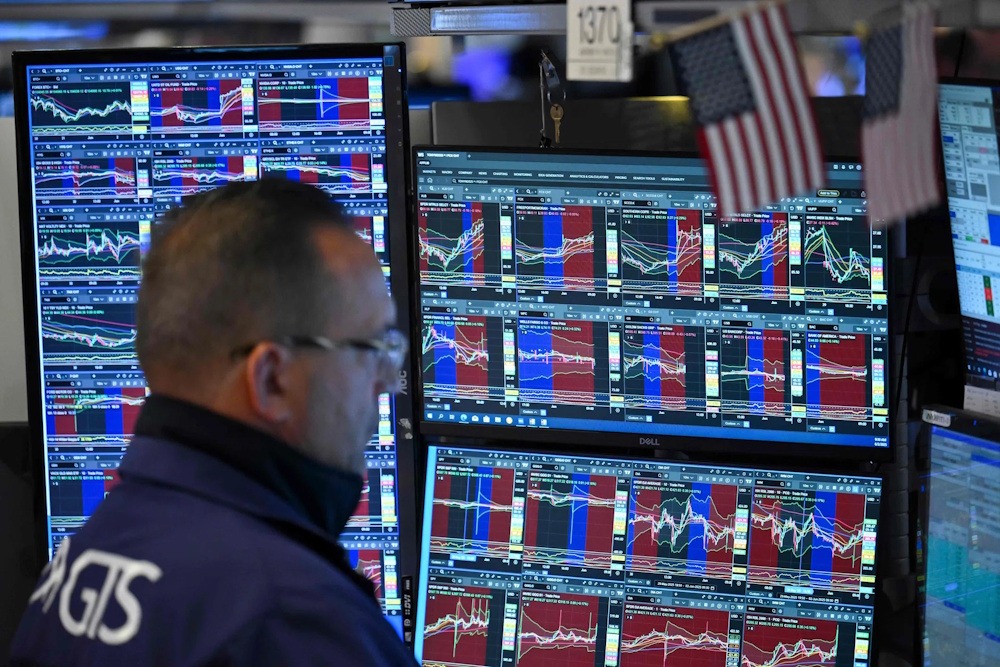
Nasdaq futures experienced a significant decline on Monday following President Donald Trump’s warning of a potential 10% tariff on imports from eight European nations that are resisting US oversight of Greenland. Futures associated with the S&P 500 experienced a decline of 1.2%, whereas futures for the Dow Jones Industrial Average fell by approximately 1%. Contracts associated with the tech-heavy Nasdaq 100 experienced a decline of 1.5%, as reported. The New York Stock Exchange, Nasdaq, and US bond markets were closed on Monday, January 19, in observance of Martin Luther King Jr. Day. In the interim, the principal equity indexes in Europe experienced a significant decline. Germany’s DAX experienced a decline of 1.3%, while the CAC 40 in Paris saw a reduction of 1.5%. Britain’s FTSE 100 experienced a decline of 0.5% during Monday morning trading. The European nations affected by Trump’s tariff threats condemned his actions, asserting that they “undermine transatlantic relations and risk a dangerous downward spiral.” A notably robust joint statement from Denmark, Norway, Sweden, France, Germany, the United Kingdom, the Netherlands, and Finland represents the most emphatic denunciation from European allies since Trump’s return to the White House nearly a year ago. According to Stephen Innes, Trump’s actions are putting to the test the strategic alignment and institutional trust that form the basis of support from Europe, which stands as the largest trading partner and financier for the United States.
In Asia, equity markets exhibited a mixed performance following China’s announcement of a 5% annual economic expansion for 2025, despite a deceleration observed in the final quarter. Robust exports, in spite of Trump’s elevated tariffs on imports from China, contributed to mitigating the impact of relatively subdued domestic demand. Hong Kong’s Hang Seng index experienced a decline of 1%, whereas the Shanghai Composite index recorded an increase of 0.3%. In Tokyo, the Nikkei 225 declined 0.7%. Japanese Prime Minister Sanae Takaichi is scheduled to conduct a news conference later on Monday as she gears up to dissolve the parliament in anticipation of a snap election next month. In other parts of Asia, South Korea’s Kospi surged by 1.3%, advancing deeper into record territory, driven by robust performances from technology-related firms. SK Hynix, a prominent player in the semiconductor industry, experienced an increase of 1.1%. Taiwan’s Taiex experienced an increase of 0.7%, whereas India’s Sensex recorded a decline of 0.6%.
On Friday, equities experienced a slight decline as the inaugural week of corporate earnings season concluded, with markets hovering close to record highs. The S&P 500 experienced a decline of 0.1%, while the Dow industrials recorded a decrease of 0.2%. The Nasdaq composite experienced a decline of 0.1%. All experienced weekly losses, whereas stocks of smaller companies performed comparatively better. The Russell 2000 recorded a modest increase of 0.1%. Technology stocks served as the primary drivers of market movements for the majority of the day. A number of prominent technology stocks exhibited significant increases, thereby mitigating losses in other sectors. Earnings updates could provide investors with a clearer understanding of consumer spending patterns and the performance of businesses amid ongoing inflationary pressures and elevated tariffs. Investors are closely examining results from the technology sector to determine if the elevated stock prices, driven by the enthusiasm surrounding artificial intelligence, are warranted. This week is set to deliver a diverse array of earnings reports from the airline sector, industrial firms, and technology enterprises. United Airlines, 3M, and Intel are set to announce their quarterly earnings results.
This week, the U.S. central bank will receive an additional update on inflation through the government’s release of the personal consumption expenditures price index, commonly referred to as the PCE. The Federal Reserve regards this as its favored metric for assessing inflation. The upcoming policy meeting of the Federal Reserve is scheduled for two weeks from now, where it is anticipated that the central bank will maintain its existing benchmark interest rate. This decision comes as it seeks to navigate the challenges posed by a decelerating labor market alongside persistently elevated inflation, which continues to exceed the Fed’s target of 2%. In other transactions early Monday, U.S. benchmark crude oil declined by 37 cents to $58.97 per barrel. It has stabilized following a period of significant volatility amid extensive protests in Iran directed at the nation’s leadership. Brent crude, the international benchmark, declined by 45 cents to $63.68 per barrel. The price of gold continued its ascent, increasing by 1.6%, whereas the price of silver surged by 4.4%. The U.S. dollar appreciated to 157.99 Japanese yen, up from 157.93 yen. The euro appreciated to $1.1626, up from $1.1581.