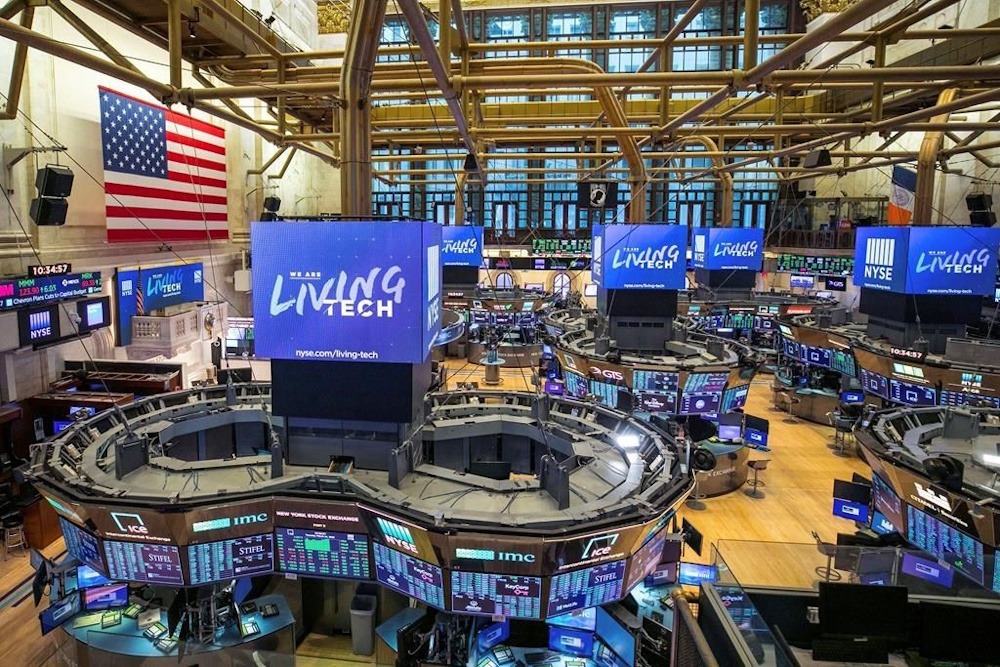
U.S. futures are showing an increase as the technology sector seeks to rebound following a notable drop in artificial intelligence stocks seen last week. Futures for the S&P 500 experienced an increase of 2.9% on Monday, while those for the Dow Jones Industrial Average saw a rise of 2.1%. Nasdaq futures saw a rise of 3.6%. AI-related stocks such as Nvidia, Broadcom, and Advanced Micro Devices experienced significant selling pressure on Friday; however, all three saw a notable increase prior to the market opening on Monday. Nvidia’s stock experienced an increase of 8.2% in premarket trading, while shares of Advanced Micro Devices saw a rise of 4.3%. Broadcom’s stock experienced an increase of 5.5%. Anthropic, the creator of the Claude AI tool, saw a 4.2% rise ahead of the market opening after a successful IPO on Thursday. Shares of AI companies have encountered considerable pressure in recent weeks, with certain analysts contending that the high company valuations and substantial expenditures are unjustified.
CrowdStrike announced its acquisition of Zscaler in a $44 billion, all-stock transaction, marking a significant consolidation within the cybersecurity sector on Monday. Shares of CrowdStrike declined by 7.4% on Monday, while Zscaler’s shares surged by 18.6%. “We view this as the clearest signal yet that cybersecurity is consolidating into a handful of platforms, with the AI era forcing the hand of vendors who had been content to partner,” stated Dan Ives. The U.S. stock market will be closed on Thursday in observance of Thanksgiving, followed by a shortened trading session on Friday. However, this week will showcase a number of economic indicators that are poised to draw considerable interest. The Conference Board is set to release its consumer confidence index on Tuesday. On Wednesday, the Commerce Department is set to unveil data pertaining to consumer spending and inflation for the month of October.
In September, the Federal Reserve’s preferred measure of inflation, the personal consumption expenditures price index, recorded a rate of 3.1%. The department is poised to unveil its second estimate for U.S. economic growth for the third quarter on Wednesday. The initial estimate indicated a growth rate of 3.4% for the period spanning July to September, propelled by robust consumer expenditure and investments in artificial intelligence. That exceeded the growth rate of 2.2% recorded in the second quarter. Oil prices experienced a decline on Monday, driven by a rebound in supply that continued to ease concerns, even in the face of the persistent absence of a permanent agreement between the U.S. and Iran regarding the ongoing conflict.
Analysts project a continued decrease in oil and fuel prices as global supply reaches a state of stability, which may help to ease certain inflationary pressures. Brent crude oil, the international benchmark, declined by 1.9% to $90.83 per barrel; however, this price remains significantly higher than the approximately $72 per barrel observed in late February prior to the onset of the conflict. Benchmark U.S. crude experienced a decline of 1.7%, concluding at $82 per barrel. In Europe, Britain’s FTSE 100 recorded a rise of 0.6%, attaining a value of 10,411.63. France’s CAC 40 experienced an uptick of 0.7%, reaching 7,981.21, while Germany’s DAX recorded a gain of 0.8%, climbing to 25,017.10. Markets in Tokyo were closed for a holiday, while other Asian markets saw a decline. The U.S. dollar appreciated to 159.08 Japanese yen, up from 158.62 yen. The euro decreased to $1.0963 from $1.10973.