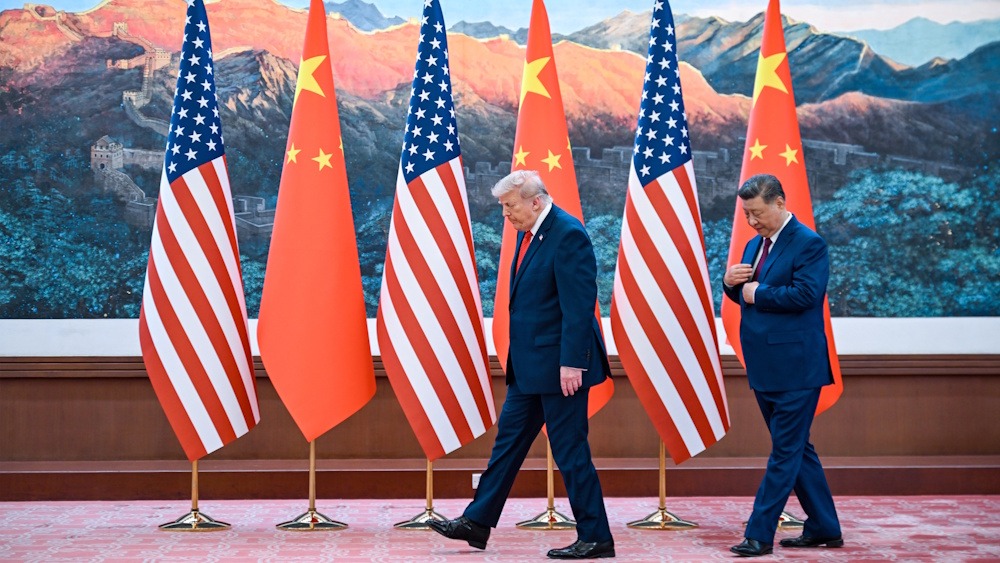
U.S. President Donald Trump characterized the discussions with Chinese counterpart Xi Jinping as “extremely positive and constructive” during a high-stakes visit to China on Thursday. During a state banquet in Beijing, Trump characterized Xi as a “friend” and referred to his reception in China as “magnificent.” Discussions to date between the two leaders have been characterized as “all good” for both nations, according to Trump, who extended an invitation to Xi for a visit to the U.S. in September. “We have a chance to create a future of greater cooperation and prosperity,” Trump stated. Xi emphasized having had a “in-depth exchange of views” with Trump, underscoring the necessity for the two nations to “become partners, not rivals.” He pointed out that such a relationship can only be stable through “mutual respect.” Neither Trump nor Xi provided details regarding their discussions, which are anticipated to focus on significant topics such as trade, Taiwan, and artificial intelligence. Previously, the Wall Street Journal indicated that Trump and Xi engaged in discussions regarding the potential for increased access for U.S. companies to the Chinese market. According to a White House readout, the report indicated that Trump and Xi discussed “ways to enhance economic cooperation,” including the expansion of Chinese agricultural purchases and initiatives aimed at reducing the quantity of fentanyl ingredients exported to the U.S. from China.
Chinese sources indicated that Xi cautioned about the potential for clashes and even conflicts between the U.S. and China regarding Taiwan, should the situation be mismanaged. Trump indicated this week that he would address the issue of arms sales to Taiwan with Xi. China has consistently asserted its claim over Taiwan as part of its territory and has issued warnings regarding U.S. involvement in the matter. Xi was reported to have engaged with U.S. business leaders. A number of prominent executives accompanied Trump on his trip, among them Tesla’s CEO Elon Musk, Apple’s CEO Tim Cook, and Boeing’s CEO Kelly Ortberg. In his opening remarks on Thursday, Xi contended that the common interests shared by the U.S. and China significantly surpass their differences, calling on both nations to designate 2026 as a year of renewal in their bilateral relationship. Trump asserted that the bonds between the U.S. and China will be “better than ever before.” The president’s journey signifies the inaugural state visit to China by a U.S. leader in almost ten years, following Trump’s visit to Beijing shortly after the onset of his first term. However, relations between Washington and Beijing have become increasingly tense, particularly following a contentious trade conflict that persisted throughout much of 2025 and ongoing disputes regarding AI chips. Prior to his journey, Trump indicated he would request Xi to “open up” China to U.S. business.
U.S. Treasury Secretary Scott Bessent, who engaged with Chinese Vice Premier He Lifeng in South Korea on Wednesday to establish a foundation for the discussions, indicated that he anticipated an announcement regarding substantial Chinese orders for Boeing’s aircraft during Trump’s visit. Shares of Boeing experienced an uptick in premarket trading subsequent to the remarks made. Bessent noted that Trump and Xi will also engage in discussions regarding additional purchases of energy and agricultural goods, along with non-strategic sectors where China might consider investing in the U.S. The United States has authorized approximately 10 Chinese firms to acquire Nvidia’s H200, its second-most powerful AI chip, although no deliveries have occurred as of yet, according to sources. Nvidia’s CEO Jensen Huang is traveling with Trump to China, heightening anticipation that a significant agreement may be achieved to facilitate the sales of the H200 in the region. Bessent remarked that the report was “news to me” and characterized the “back and forth” on the H200 as a “Commerce Department function.” However, Bessent asserted that discussions surrounding AI will be “fulsome,” attributing this to the fact that the U.S. is “in the lead” in the development of this emerging technology. The discussions are anticipated to address the U.S. and Israeli military actions against Iran, which have significantly interrupted essential oil supplies to a large portion of Asia for several months.
Some analysts have posited that Trump might seek to convince China, a significant importer of Iranian oil, to assume the role of a guarantor for a durable peace agreement, though it is unclear if Beijing would be inclined to take on such a responsibility. “The market could be pinning too much hope on the U.S.-China talks yielding some positive results on Iran,” analysts noted. Source reported that Tehran has permitted the passage of Chinese vessels in the Strait of Hormuz, a crucial maritime route off Iran’s southern coast, through which approximately one-fifth of global oil transportation occurs. The strait, concurrently obstructed by both the U.S. and Iran, has effectively been closed to tanker traffic for an extended period, leading to an increase in oil prices and raising concerns about potential inflationary pressures. Bessent expressed his belief that China will “do what it can” regarding the strait. He added, “I think they will work behind the scenes to the extent anyone can sway Tehran.” This week has revealed indications that inflation is accelerating in the U.S., as measures of consumer and producer price growth have exceeded expectations, primarily driven by the energy shock resulting from the Iran war. Oil prices currently stand significantly higher than the pre-war benchmark of $70 per barrel. However, Bessent forecasted that price increases will moderate “quickly” once the cost of crude starts to decline.