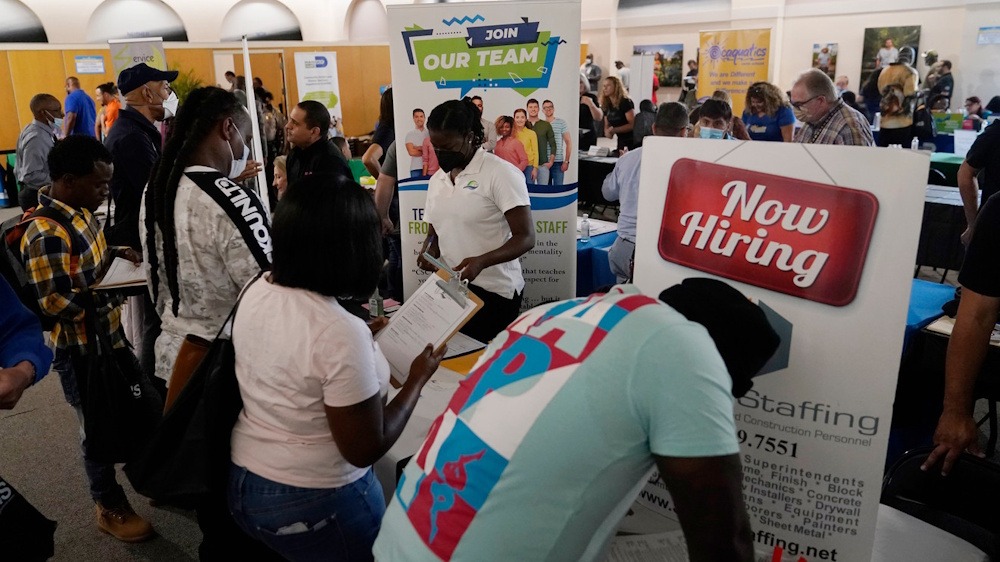
US job growth accelerated in October, with the unemployment rate declining to 4.1%. This development indicates a potential strengthening of the labour market following a mid-summer slowdown, which may influence the Federal Reserve’s decision to raise interest rates in December. The Labour Department’s closely monitored employment report on Friday indicated that the economy added 84,000 additional jobs in August and September compared to earlier estimates. The unemployment rate decreased from 4.2% in September, even as more individuals entered the labour force, presumably in an effort to mitigate the impact of rising living costs stemming from the conflict in the Middle East. The better-than-expected report followed on the heels of data this week showing a rise in job openings in September, which combined with historically low layoffs has raised the spectre of the labour market tightening. “The labor market is heating up across-the-board and supports our view that the Fed will raise the policy rate again in December,” said Kathy Bostjancic. Nonfarm payrolls increased by 165,000 jobs last month, following an upward revision of 60,000 jobs gained in September, according to the Labour Department’s Bureau of Labour Statistics. Economists surveyed by Reuters had anticipated an increase in payrolls of 65,000, following a previously reported rise of 29,000 in September.
Estimates varied between 35,000 and 125,000 jobs. August’s employment gains were adjusted to 186,000, an increase from the earlier estimate of 133,000. Employment growth averaged 137,000 over the last three months, contrasting with an average loss of 45,000 during the corresponding period in 2025. Some economists expressed scepticism regarding the labour market’s newfound strength. “Recent improvements in the employment situation largely relate to a major jump in federal government spending in the third quarter, as well as an unprecedented surge in election spending reported to be near $12 billion within a relatively short time frame of August to October,” said Brian Bethune. Last month’s broad-based increase in payrolls was led by the professional and business services industry, which added 70,000 jobs, well above the average monthly gain of 15,000 over the past 12 months. Those jobs were in professional, scientific and technical services as well as administrative and support, waste management and remediation services. Healthcare employment rose by 42,000 positions, primarily within hospitals and home healthcare services. The transportation and warehousing sector experienced an increase of 25,000 positions, predominantly among couriers and messengers, reflecting robust domestic demand. Manufacturing payrolls experienced an increase of 19,000 jobs, with gains observed in the sectors of computer and electronic products, machinery, and primary metals. The increases appear to be associated with the expansion of artificial intelligence infrastructure. There were modest job gains in the retail, financial activities, and government sectors.
Construction experienced a reduction of 3,000 jobs, primarily affecting residential speciality trade contractors. Employment in residential building construction has also seen a decline, influenced by elevated mortgage rates that have adversely affected homebuilding activities. Home renovations have also been experiencing a downward trend.
Employment in the leisure and hospitality sector experienced a decline of 13,000 positions, primarily within the accommodation and food services segment. The proportion of industries indicating growth last month rose to 57.6%, up from 54.2% in September. The average workweek remained stable at 34.4 hours. Financial markets have adjusted their expectations, now reflecting an approximately 80% probability of a rate hike at the upcoming meeting of the US central bank, an increase from the previous 66.9% noted on Thursday, according to CME’s FedWatch tool. The Fed last week maintained its benchmark overnight interest rate within the 3.75%-4.00% range. Next Tuesday’s consumer inflation report for October may provide additional insights into the trajectory of monetary policy in early 2027. Economists are closely monitoring the stock market following a significant downturn in the tech sector on Thursday, driven by concerns that a Democratic-led Congress may implement stricter regulations on artificial intelligence. Stocks on Wall Street experienced an upward movement. The dollar appreciated against a range of currencies. US Treasury yields experienced an increase.
Economists have estimated that the economy must generate a minimum of 40,000 jobs each month to align with the growth in the working-age population. The breakeven rate has decreased from approximately 150,000 in 2024, attributed to a reduced labour force resulting from the Trump administration’s stringent immigration policies.
Household employment, known for its volatility, saw an increase of 463,000 in October, surpassing the 421,000 individuals who joined the labour force. Approximately 1.589 million individuals have entered the labour force in the last three months, resulting in an increase in the participation rate to 61.9%, up from 61.6% in August. However, a significant number of them, primarily those re-entering the workforce, have yet to secure employment. Young adults find themselves largely excluded from the labour market, as artificial intelligence has led to the elimination of certain entry-level positions. The median duration of unemployment increased to 11.9 weeks, marking the longest period since November 2021, up from 11.5 weeks in September. Last month, the number of individuals engaged in part-time work for economic reasons rose by 339,000, bringing the total to 4.840 million. A broader measure of unemployment, which encompasses individuals desiring employment but who have ceased their job search, as well as those engaged in part-time work due to an inability to secure full-time positions, increased to 7.9% from 7.6% in September. Historically low layoffs have provided stability to the labour market. Despite a rise in hiring, it has not kept pace with economic growth, as gross domestic product expanded at an annualised rate of 3.4% in the third quarter.
Economists indicated that the uncertainty stemming from the US-Israeli conflict with Iran, along with the implications of AI on staffing requirements, has resulted in businesses being reluctant to expand their workforce. “More than a quarter of unemployed workers were searching for six months or longer in October, a share rarely seen outside the aftermath of a recession,” said Cory Stahle. “And even when employers do hire, job posting data suggests that they have increasingly tilted their hiring toward experience, leaving people early in their careers with even fewer ways in.” Wage growth continued at a steady rate, rising 3.1% over the 12 months ending in October, following a 3.2% increase in September. While that underscored the disinflationary impulse from the labour market, it illustrated the ongoing decline in household incomes. In September, consumer prices experienced a year-on-year increase of 3.7%.
Discontent regarding inflation led to the Republican Party, under President Donald Trump, ceding control of Congress to the Democrats in the midterm elections held on Tuesday.”The American public will continue to skeptically look at the current economic expansion which is highly skewed towards upper- end households and corporates that are profiting from strong underlying demand and robust non-residential investment,” said Joseph Brusuelas.