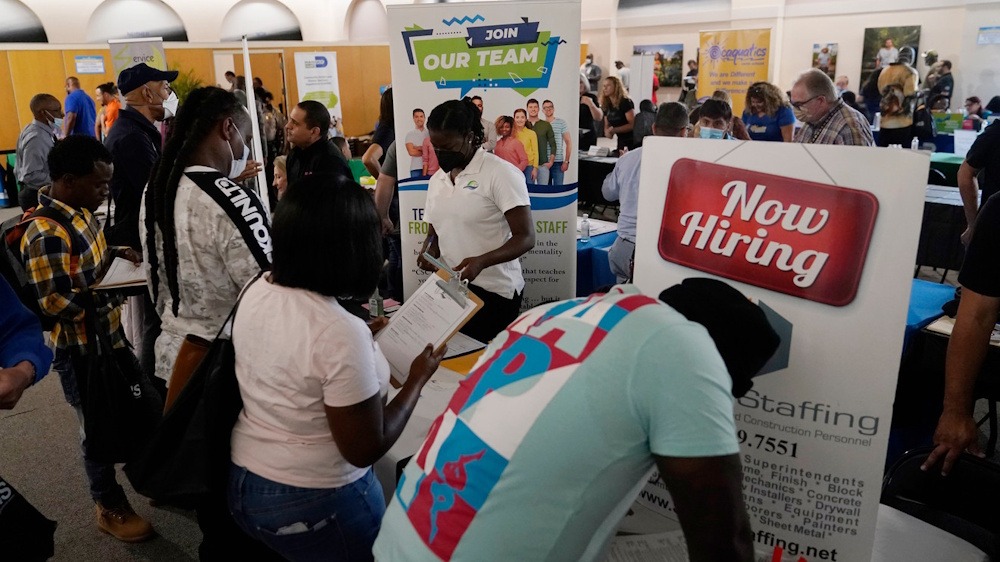
The U.S. economy experienced a lower-than-expected job addition in June, although the unemployment rate saw a decline. These figures, released on Thursday, may influence the Federal Reserve’s monetary policy considerations in the upcoming months. Total nonfarm payrolls increased by 57,000 last month, falling short of the anticipated 114,000, according to data from the Labour Department’s Bureau of Labour Statistics. Robust performance in professional and business services, along with social assistance and health care, mitigated the typical seasonal downturn in hiring observed within the leisure and hospitality sectors. Employment in accommodation and food services experienced a decline of 55,000, a significant downturn considering the context of the ongoing FIFA World Cup football tournament and the approaching Independence Day celebrations on July 4th, analysts noted.
May’s payrolls number was revised down by 43,000 to 129,000. When combined with a distinct downward adjustment in April, employment in the two months preceding June was 74,000 lower than previously reported. The jobless rate, meanwhile, inched down to 4.2%, versus estimates of 4.3% — a level it has maintained since March. The labour participation rate decreased by 0.3 percentage points to 61.5%, and the employment-to-population ratio edged down to 59%, according to the source. “There was little consolation to be taken in the tick down in the unemployment rate,” analysts said. June’s soft payrolls total interrupts a three-month sequence of stronger-than-expected employment data. In light of the recent indicators suggesting robustness in the job market, market participants have speculated that Federal Reserve officials, keen to avert the escalation of inflationary pressures stemming from energy costs, may possess greater latitude to increase interest rates this year.
However, the most recent NFP reading may undermine that hawkish perspective, leading to a recalibration of expectations to a range of zero to one rate increases in 2026, in contrast to earlier projections of one to two hikes, analysts noted in a report. “[T]he combination of relatively soft labor conditions and the sharp fall in oil should finally bring material yield relief to equities,” they wrote. Wall Street stock futures indicated an upward trajectory following the payrolls report, as benchmark 10-year and rate-sensitive 2-year U.S. Treasury yields experienced a decline. Yields typically exhibit an inverse relationship with prices. Before the announcement, financial markets had estimated approximately a 50.7% probability that the Fed might increase rates during its September meeting. In June, the central bank maintained its interest rates within the range of 3.5% to 3.75%. However, new projections suggested that officials expect a rate increase to occur later this year. In theory, increasing interest rates can assist in controlling inflation, a concern for policymakers who worry that it may escalate due to a surge in oil prices following the initiation of a joint U.S.-Israeli military operation against Iran in late February.
However, crude prices have retreated to approximately pre-conflict levels following the establishment of a framework peace agreement between the U.S. and Iran in June, alleviating some of these concerns. On Wednesday, newly appointed Fed Chair Kevin Warsh indicated that the risks associated with inflation had diminished, yet he refrained from offering any forward guidance regarding interest rates. In addition to managing inflation, the Federal Reserve is responsible for adjusting interest rates to foster maximum employment. An increase in rates may exert pressure on the overall economy and subsequently impact hiring activity. On the whole, the June jobs data presents the Fed with the portrait of an American labor market that has “stabilized in recent months” but is “not yet reaccelerating,” the analysts including Bradley Saunders said.